
Week of March 16, 2026 in Review
Fed Hits Pause Again, but Not Without Debate
As expected, the Federal Reserve kept its benchmark Federal Funds Rate unchanged at 3.50%-3.75%. This follows a similar pause in January, after three rate cuts late last year. While the Fed Funds Rate doesn’t directly set mortgage rates, it strongly influences borrowing costs across the economy.
What’s the bottom line? The decision to hold was widely anticipated, but it wasn’t unanimous. Governor Stephen Miran supported another quarter-point rate cut, highlighting the Fed’s balancing act. Inflation remains above target, limiting the Fed’s ability to ease policy, while signs of a cooling job market may increase pressure to lower rates in the months ahead. The Fed also pointed to uncertainty around global events, particularly tensions in the Middle East, as a potential risk to the U.S. economic outlook.
New Home Sales Plunge, Builders Stay Cautious
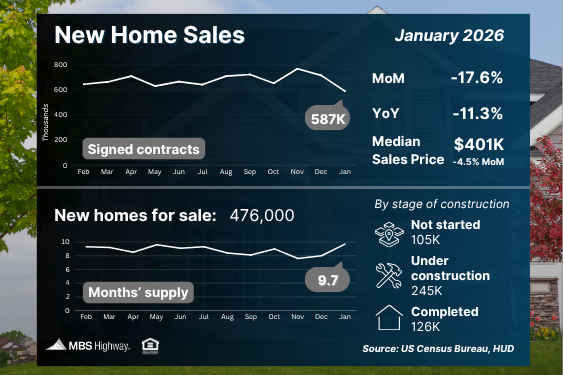
New home sales (signed contracts) fell nearly 18% from December to January, reaching a 587,000 annual pace. While below expectations, the drop follows stronger sales in November and December, with January’s harsh weather likely playing a role.
Builder sentiment remains cautious. The National Association of Home Builders Housing Market Index edged up one point in March to 38. Readings below 50 indicate more builders view conditions as poor than good. Affordability challenges and higher construction costs continue to weigh on confidence.
What’s the bottom line? While the monthly drop in signed contracts drew attention, the broader trend tells a steadier story. The average pace of sales over the most recent three months (688,000) is very close to the prior three-month average (692,000), suggesting overall demand hasn’t shifted dramatically.
Pending Home Sales Edge Higher
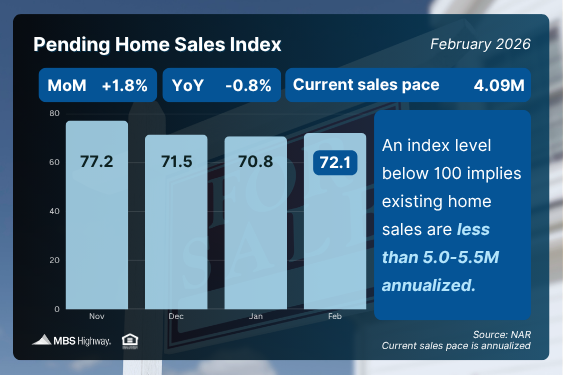
While new home sales saw a sharp pullback, pending sales for existing homes edged up 1.8% from January to February, though they remain 0.8% below last year. February activity was generally positive across the South, West, and Midwest, while the Northeast still faced winter-related slowdowns.
What’s the bottom line? February activity came in better than expected and likely would have been even stronger without the storms in the Northeast. The uptick was likely supported by improved affordability and lower rates at that time, but it remains to be seen whether that momentum can continue amid recent market volatility tied to the Iran conflict.
Quick Take: Wholesale Inflation and Unemployment
Wholesale inflation came in hotter than expected in February. The Producer Price Index (PPI) rose 0.7% for the month and 3.4% year over year. Core PPI (which excludes food and energy) also topped forecasts, increasing 0.5% monthly and 3.9% annually.
On the labor side, initial jobless claims fell by 8,000 to 205,000. However, continuing claims rose by 10,000 to 1.857 million, indicating that many job seekers are taking longer to find full-time work. Some may also be turning to gig or part-time roles, which aren’t fully reflected in the data.
Family Hack of the Week
Celebrate the start of baseball season with this crowd-pleasing Caramel Popcorn recipe courtesy of Delish. Yields 8 servings.
Preheat your oven to 250 degrees Fahrenheit and line a rimmed baking sheet with foil. Pop 6 cups of popcorn and set aside.
In a large pot over medium-high heat, melt 1/2 cup of butter, then stir in 1 cup of brown sugar and 1/4 cup of light corn syrup. Bring the mixture to a boil, stirring constantly so it doesn’t burn, then reduce the heat and let it simmer for about 5 minutes. Whisk in 1 teaspoon of kosher salt, 1/4 teaspoon of baking soda, and 1 teaspoon of vanilla.
Pour the caramel over the popcorn and toss until evenly coated, then spread it out in an even layer on the prepared baking sheet. Sprinkle lightly with flaky sea salt and bake for about 1 hour, stirring every 15 minutes, until the popcorn is deep golden and crisp.
Let it cool completely, then break it into pieces and store in an airtight container for up to a week.
What to Look for This Week
With little economic data on the calendar beyond Thursday’s jobless claims, expect oil price swings to be the main market mover.
Technical Picture
Mortgage Bonds declined sharply on Friday, breaking below a key support level. The 10-year Treasury yield moved above the 4.332% Fibonacci level, indicating yields may have room to move higher toward 4.42%.
https://mbshighway.com/hwapp/globalfeatures/newsletter/live-share/?articleID=69bd5dfc8670d60c9a18701c&loId=TO_1ZzEBPqhWwEMb-1_pk_-V80BeL-bVZY4c2dvPD_VzuY0OYTqAPEhaQG-t7axd